
The NBA has always been a league of fine margins, but the 2025/26 season pushes those margins even tighter. It’s not just the number of games (still 82) — it’s how they are clustered: frequent back-to-backs, heavy travel, short recovery windows, and extra competitive fixtures tied to the NBA Cup. When fatigue becomes routine, it stops being a background factor and starts shaping availability, shot quality, fourth-quarter execution and, ultimately, results. This article explains what schedule density looks like in 2025/26 and why it meaningfully changes both injury patterns and offensive output, with concrete examples that can be applied when assessing teams week to week.
1) What “schedule density” looks like in 2025/26 (and why it matters)
The simplest way to describe the calendar load is to look at back-to-backs. In the 2025/26 season, teams still deal with frequent stretches where they play on consecutive nights. Even when the league tries to reduce extreme congestion compared to previous decades, the reality is that back-to-backs remain a built-in feature of fitting 82 games into a fixed window. This matters because back-to-backs are not only about one tired night — they often affect several games in a row through minutes management and reduced practice intensity.
Density also includes sequences where teams have only one day between games but must travel across time zones. That “one day off” is rarely a true recovery day when flights, hotel routines, media, and reduced sleep quality are factored in. A club can technically have rest on paper while still being under-recovered physically, which is why many performance analysts focus on travel patterns, not just the raw count of back-to-backs.
The NBA Cup adds an extra competitive layer into an already tight calendar. In 2025/26, group-stage fixtures and knockout matches create a period where teams often treat certain regular-season games with playoff-level urgency. Even if these games are integrated into the broader schedule, they can increase intensity during a time when players are still building early-season conditioning — a combination that can raise both performance volatility and physical risk.
How “rest advantage” quietly swings outcomes
When one team plays its second game in two nights and the opponent is rested, the difference often shows up in the least glamorous areas: transition defence, second jumps for rebounds, and the ability to contest shots without fouling. Coaches tend to simplify defensive coverages on short rest to reduce mental and physical load, but that can produce cleaner looks for opponents, especially from the corners and in early offence.
Another overlooked effect is the “carryover” impact. A difficult schedule spot doesn’t end when the buzzer sounds. If a player logs heavy minutes during a back-to-back, they may require reactive rest later in the week, or they may appear in the next game at reduced explosiveness. That creates ripple effects for rotations and can turn a single dense stretch into a broader availability issue.
Late-game execution is where fatigue is most visible. It’s not always about missing shots — it’s about the defence being half a step late on the second and third actions of a possession. The extra cut, the one-more pass, the final close-out: these moments decide close games, and schedule-driven fatigue can be the reason a team repeatedly loses tight finishes even if their season averages look solid.
2) Injuries: what increases, why it increases, and what 2025/26 adds to the mix
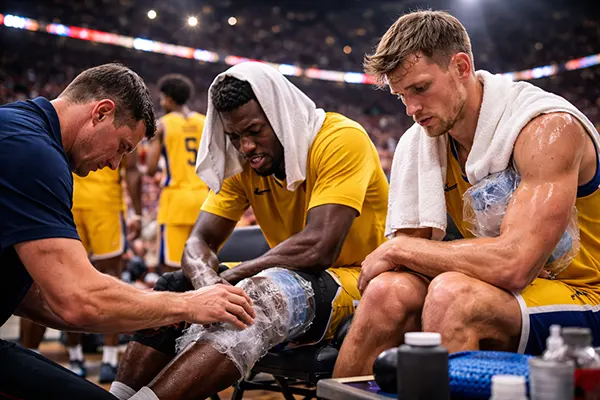
The clearest injury signals in the NBA tend to appear when scheduling becomes condensed, because the body has less time to recover between high-intensity efforts. Research and injury tracking over multiple NBA eras have shown that compressed fixtures can increase overall injury incidence — not because every short-rest game causes a problem, but because repeated exposure to fatigue raises risk. The key issue is the accumulation of stress rather than a single isolated incident.
Soft tissue injuries, in particular, are closely linked to fatigue. Hamstrings, calves, adductors and groins tend to appear frequently during congested periods because modern basketball demands repeated acceleration and deceleration. A player may sprint into spacing, stop sharply, change direction to defend, then sprint again — and do that dozens of times per game. If recovery windows are limited, the likelihood of strain increases.
In 2025/26, teams are also working under stricter expectations around star participation. The league’s approach to player availability encourages teams to avoid sitting key names without clear medical justification. As a result, some load management strategies have shifted from “rest the player” to “reduce the load”: fewer minutes, fewer high-stress defensive assignments, selective scheduling of intense practice sessions, and more careful sequencing of travel routines.
Why soft tissue problems show up first
Soft tissue injuries are often the first warning sign because they are directly affected by neuromuscular fatigue. When players are tired, coordination declines slightly — not enough to be obvious to casual viewing, but enough to increase strain during explosive actions. A hamstring or calf issue can be the result of one awkward step, but the real cause is usually a fatigue context built over several days.
Sleep disruption is a major driver here. Teams can have “days off” that still include late arrivals, time zone changes, and reduced sleep quality. Even elite athletes struggle to fully recover when their sleep schedule is repeatedly shifted. Over weeks, that becomes a performance and injury factor that is difficult to solve with standard rest alone.
Competitive intensity also matters. In-season tournament fixtures and nationally prominent games can push stars to play through minor discomfort that might normally be managed conservatively. Even if the player remains available, compensating movements can shift stress to other areas, which is why medical staffs monitor movement patterns and workload trends, not only injury status.
3) Scoring and efficiency: why a tired league can still produce big points
It’s logical to assume fatigue would reduce scoring, but in practice schedule density can increase points in several ways. Defence often drops before offence does. Defending at NBA level demands constant communication, rotations, and repeated close-outs. When that effort slips even slightly, offences gain cleaner looks — more open threes, more uncontested drives, and fewer disrupted possessions.
Coaches also adapt schemes to protect energy. On short rest, teams may defend more conservatively: less full-court pressure, fewer aggressive traps, more switching or more drop coverage depending on personnel. These choices can reduce physical load, but they can also increase efficiency for opponents if matchups are favourable or if shooters get rhythm early.
Rotation patterns further influence scoring. In congested weeks, some teams prioritise consistent offensive structure because there is less time for heavy practices. That can help spacing and shot quality, producing high offensive ratings even when players are tired. However, it can also make teams easier to scout, meaning the effect can be stronger in the regular season than in the postseason, where opponents game-plan in detail.
What to watch when predicting scoring swings
The first thing to check is whether both teams are equally rested. When one team is on short rest and the other is fresh, you often see scoring spikes through fatigue-driven sources: transition baskets, late close-out fouls, and second-chance points. These do not always show up in season-long averages, but they can define individual matchups.
The second factor is lineup stability. When rotations are disrupted by injuries or minutes restrictions, defensive communication suffers. Offence benefits from that chaos, especially early in games. A team can have its stars active but still field unusual defensive units because returning players are capped or because role players are pushed into unfamiliar assignments.
The third factor is the calendar context around the game. Teams starting long road trips, finishing travel-heavy stretches, or coming off intense NBA Cup fixtures can show unusual shot profiles — either relying more on threes because rim pressure is tiring, or attacking the rim more because jumpers fall short. These patterns are subtle, but over a season they explain why some clubs look inconsistent without any single dramatic cause.