
Roland-Garros remains the most demanding Grand Slam tournament for live bettors because clay courts create conditions that differ significantly from hard and grass surfaces. In 2026, the men’s and women’s tours continue to feature powerful baseline players, but clay still rewards patience, point construction and tactical adaptation. For those using live betting markets, understanding how the tempo of a match changes can be more valuable than simply following the score. A player may be leading on the scoreboard while losing control of rallies, physical momentum and court positioning. Recognising these signals early can help bettors react before the odds fully adjust.
Why Match Tempo Matters More on Clay Courts
Clay slows the ball after the bounce and allows players to retrieve shots that would often become winners on faster surfaces. As a result, rallies are longer, breaks of serve occur more frequently and momentum can shift several times within a single set. Live betting markets react to these changes, but not always immediately.
A fast tempo on clay usually appears when one player consistently takes the ball early, attacks short balls and forces shorter rallies. When this pattern develops, service games often become quicker and pressure increases on the defending player. Bettors who identify this trend before the market does may find value in game, set or match markets.
A slower tempo generally favours players with strong defensive skills, physical endurance and tactical discipline. If rallies are becoming longer and one player is repeatedly forced into extended exchanges, fatigue can gradually influence the outcome even when the score remains close.
Indicators That the Tempo Is Beginning to Change
The first sign is rally length. If average exchanges suddenly drop from eight or nine shots to four or five, one player is likely becoming more aggressive or finding better court positioning. This often happens after a tactical adjustment or a change in confidence.
Another important indicator is return depth. When returns consistently land deep near the baseline, servers have less time to control points. A player who begins winning more return points may be preparing the ground for a future break, even if previous games appeared comfortable.
Body language should never be ignored. Players who start moving forward more frequently, celebrating points with greater intensity or increasing their pace between rallies often signal growing confidence. Conversely, slower movement and visible frustration may indicate that control of the match is changing hands.
Reading Momentum Shifts During Critical Stages of the Match
Many live bettors focus excessively on break points, but momentum often changes several games earlier. A player who repeatedly reaches deuce on return games is creating pressure that may not yet be reflected in the scoreline. On clay, sustained pressure frequently produces results over time.
Physical demands are especially important during Roland-Garros. Long rallies and extended matches place considerable stress on players. If one competitor begins shortening points unexpectedly, it may indicate fatigue rather than tactical aggression. Understanding this distinction is crucial for accurate live betting decisions.
Weather conditions can also affect match tempo. Warm and dry conditions generally make clay courts slightly faster, while cooler temperatures and heavier air tend to slow play. Roland-Garros sessions in 2026 continue to feature day and evening matches, creating different playing environments that bettors should monitor closely.
How Statistics Can Confirm What You See
First-serve percentage remains one of the most useful live indicators. A declining first-serve rate often increases pressure on a player because second serves are easier to attack on clay. If this trend continues for several games, a break of serve may become increasingly likely.
Points won behind the second serve provide additional insight. When a player starts losing a higher proportion of second-serve points, it often reflects a shift in baseline control rather than a simple serving problem. This can be an early warning sign of deteriorating momentum.
Unforced errors should be analysed carefully. A temporary increase may result from tactical aggression, while a prolonged rise often signals declining confidence or physical fatigue. Combining statistical data with visual observation usually produces a more accurate assessment than relying on numbers alone.
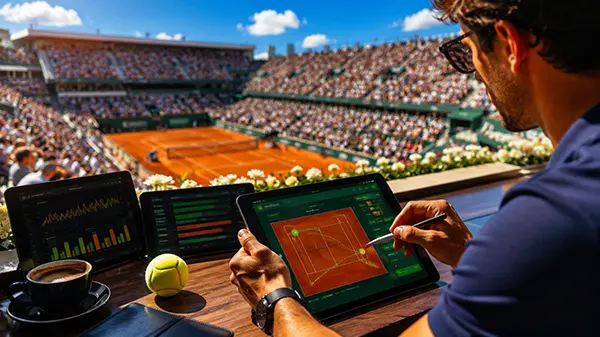
Practical Live Betting Approaches for Roland-Garros 2026
One effective approach is waiting for confirmation before entering a market. Rather than reacting to a single break of serve, experienced bettors often look for several consecutive games that demonstrate a genuine shift in tempo. This reduces the risk of responding to short-term fluctuations.
Another strategy involves identifying players known for strong clay-court endurance. During long matches, physically resilient competitors often improve as the contest progresses. If rally length is increasing and the opponent appears uncomfortable, momentum may continue moving in the same direction despite temporary setbacks.
Set betting markets can be particularly sensitive to tempo changes. A player who narrowly loses a set while controlling many underlying aspects of the match may still offer value in subsequent markets. Observing patterns rather than focusing solely on the score is essential.
Common Mistakes When Interpreting Tempo Changes
The most common mistake is assuming that every break of serve represents a major momentum shift. Clay courts naturally produce more service breaks than faster surfaces, meaning score changes should always be evaluated alongside rally patterns and player behaviour.
Another error is ignoring physical factors. Roland-Garros matches often extend beyond two or three hours, and fatigue can alter decision-making, movement and shot selection. A player may appear tactically inferior when the real issue is declining energy reserves.
Finally, many bettors react too quickly to short bursts of success. A sequence of impressive winners can influence perception, but sustainable tempo changes are usually visible across multiple games. Patience, observation and contextual analysis remain the most reliable tools for interpreting live betting opportunities on the clay courts of Roland-Garros 2026.