
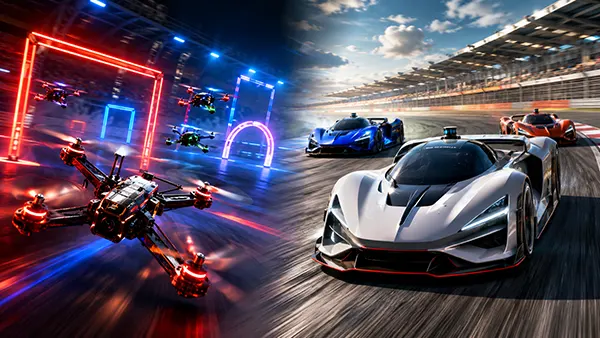
Speed contests are no longer defined only by engines, tyres and a driver sitting in a cockpit. By 2026, two rapidly developing forms of competition are reshaping what a race can look like: lightweight drones flown through three-dimensional courses and full-sized autonomous cars controlled by software. The contrast is striking. Racing drones are small, agile and usually guided by human pilots wearing first-person-view goggles, while autonomous cars carry no driver and must read the circuit, judge rivals and manage risk on their own. Yet both disciplines ask the same basic question: who can complete a demanding course fastest without losing control? Their growth has created a fresh branch of motorsport in which reaction time, code, engineering and racecraft meet in very different ways.
Two Racing Formats Built Around Different Kinds of Speed
Drone racing creates speed through proximity. A typical racing quadcopter may not match the top speed of a full-sized race car, but it can pass through narrow gates, change direction almost instantly and fly only a short distance from barriers. The pilot sees the course through a live camera feed, so every turn feels immediate and compressed. A lap may last only seconds, and a small mistake can end a heat. The FAI Drone Racing World Cup remains one of the clearest measures of the sport’s international reach. Its 2026 calendar listed events across Europe, Asia and the Middle East, with races in countries including Germany, China, South Korea, Belgium, Italy, Serbia, Türkiye and Spain. This geographical spread shows that drone racing has moved beyond isolated exhibitions and now operates as an organised international discipline.
Autonomous car racing produces a different scale of performance. The cars are larger, heavier and much faster in a straight line, but they must also manage braking zones, tyre grip, overtaking space and the behaviour of other vehicles. The Abu Dhabi Autonomous Racing League demonstrated this progression in November 2025, when six fully autonomous cars competed together in a Grand Final at Yas Marina Circuit. TUM won the race, while the leading cars fought at more than 250 km/h. The result mattered because the contest was not a single-car time trial. The vehicles had to react to traffic, choose passing opportunities and continue racing after the order changed. That moved autonomous competition closer to the uncertainty of conventional motorsport.
The difference between the two formats is therefore not simply air versus ground. Drone racing is built around compact courses, rapid changes of direction and visual precision at close range. Autonomous car racing is built around sustained speed, longer braking distances and decisions that may develop over several corners. A drone can move vertically, cut through a split gate or take a tight climbing line, giving course designers far more freedom than a circuit permits. A car remains tied to the track surface, but its mass and momentum make every decision more consequential. Both can look fast on screen, yet spectators experience the speed differently: drones appear quick because obstacles rush past the camera, while cars show speed through distance covered, braking force and wheel-to-wheel pressure.
Why the Spectacle Feels So Different
For a live audience, drone racing is often easiest to understand through onboard video. From outside the course, the aircraft can appear small and difficult to follow, especially when several are racing at once. The first-person feed solves that problem by placing viewers inside the lap. Gates arrive quickly, the horizon tilts and every correction is visible. This makes the pilot’s skill easy to recognise, even for someone who has never flown a drone. The sound also contributes to the character of the event. Racing quadcopters produce a sharp electric note that rises and falls as they accelerate, brake in the air and recover from turns. The result is a compact form of racing that feels close, fast and highly reactive.
Autonomous car racing relies more heavily on the familiar language of circuit sport. Spectators can follow position changes, corner exits, overtakes and lap gaps in much the same way as they would in a conventional race. What changes is the identity of the competitor. The team’s work is visible through the behaviour of the car rather than through a driver’s body language. A smooth pass suggests accurate prediction and confident control; a hesitant approach may reveal that the software has chosen a larger safety margin. The 2025 A2RL Grand Final gave audiences a useful example when TUM and Unimore raced closely for several laps before traffic and contact altered the contest. The drama came from racing decisions, even though no human was steering either car.
This distinction affects how organisers present the action. Drone events benefit from switching between onboard views, course maps and slow-motion replays that show how close an aircraft came to a gate. Autonomous car events need timing data, clear identification of each team and explanations of why a car changed line or reduced speed. Neither discipline can rely only on a wide camera shot. The audience must be shown what the machine or pilot is seeing and why a decision matters. When that information is delivered clearly, both sports become easier to follow. Drone racing offers immediate visual intensity, while autonomous car racing offers longer tactical battles and the unusual sight of high-performance vehicles competing without anyone in the cockpit.
Human Skill, Artificial Intelligence and the Meaning of a Driver
Most established drone racing still places a human pilot at the centre of the contest. The aircraft responds to radio commands, and success depends on hand control, visual memory, timing and the ability to remain calm after an error. The pilot does not feel the drone’s movement directly, so judgement comes from the camera image, sound and experience. This creates a distinctive kind of racecraft. A skilled pilot learns where to take a wider line for a faster exit, when to reduce speed before a difficult gate and how to recover without wasting the rest of the lap. The equipment matters, but the deciding factor is usually the person interpreting the course in real time.
Autonomous car racing removes that direct human control during the run. Engineers prepare the vehicle, test its behaviour and write the systems that handle perception, planning and movement, but the car must act for itself once it is racing. That does not remove the human contribution; it moves it earlier in the process. The team decides how cautious or aggressive the car should be, how it should respond to a rival and which information deserves priority when conditions change. The car’s behaviour on track is therefore a visible expression of many design choices. Two teams using similar machinery can produce very different racing styles because their software evaluates risk and opportunity differently.
Autonomous drone racing now sits between these two models and provides one of the most revealing comparisons. At the A2RL Drone Championship in January 2026, the aircraft raced using a forward-facing camera and an inertial measurement unit, without GPS, LiDAR or an external positioning system. TII Racing set the fastest autonomous lap at 12.032 seconds, while MAVLAB won the leading multi-drone race. In the Human versus AI final, world FPV champion Minchan Kim and the autonomous challenger reached four wins each before the human pilot won the deciding run after the AI drone struck a gate. The result showed both the progress and the remaining weakness of machine control: it can be extremely fast, but recovery and adaptability still decide close contests.
What Decides a Race in Each Discipline
In human-controlled drone racing, victory often depends on rhythm. Pilots memorise the sequence of gates and build a smooth line rather than treating each obstacle separately. The quickest lap is not always the one with the most aggressive entry into the first turn. A pilot who arrives too fast may clip a gate, lose orientation or need a wide correction that costs more time than a controlled approach would have done. Battery condition also changes the feel of the drone during a heat, so pilots must judge how hard they can push near the end. Because races are short, there may be little time to recover from one poor decision.
For an autonomous car, the central challenge is reliable judgement at high speed. The vehicle must know where it is, recognise another car, predict how that car may move and select a line that remains physically possible. It must then repeat this process many times each second while grip, speed and traffic change. The most valuable system is not simply the one that records the fastest empty-track lap. It is the one that can keep making good decisions when the ideal line is blocked. The 2024 Indy Autonomous Challenge at Indianapolis offered a strong example when a car lost GPS connectivity and shifted to LiDAR-based localisation to stop safely, while the following car detected the problem and also avoided a collision.
Race format also changes what teams optimise. A drone time trial rewards the cleanest and shortest route through the gates. A multi-drone heat adds collision risk and disturbed airflow from nearby aircraft. An autonomous car time trial rewards accurate braking and stable cornering, while a multi-car race demands overtaking logic, defensive positioning and safe reactions to unpredictable events. This is why direct speed comparisons can be misleading. A drone and a car are solving different sporting problems. The better comparison is how close each competitor operates to its own limits and how consistently it can complete the task when pressure, traffic and small errors are introduced.
Why These Competitions Matter Beyond Entertainment
High-speed racing gives developers a controlled place to test situations that would be difficult or unsafe to reproduce on public roads or in ordinary airspace. Autonomous cars face rapid closing speeds, sudden line changes and limited time to react. Racing drones must identify gates, estimate distance and correct their path while moving quickly through a confined course. These conditions expose weaknesses early. A system that works well at low speed may struggle when sensor information changes rapidly or when a small delay produces a large error. Competition makes those weaknesses measurable because every lap produces a time, a position and a clear record of success or failure.
The transfer to everyday transport is not automatic, and racing should not be presented as proof that fully autonomous vehicles are ready for every road. A circuit is controlled, mapped and separated from normal traffic. Public streets contain pedestrians, poor weather, roadworks and countless unusual situations. Even so, racing can improve specific abilities such as high-speed object detection, emergency response, vehicle stability and decision-making under pressure. The Indy Autonomous Challenge has used full-sized cars to test these abilities since 2021. In 2025, an autonomous Maserati MC20 associated with the programme reached 318 km/h at the Kennedy Space Center, while an IAC AV-24 later completed a 58.3-second lap at Autodromo di Modena, beating a previous 59.3-second human-driven record on that layout.
Drone racing has equally practical value, particularly for compact autonomous aircraft. Fast visual navigation can support future work in inspection, emergency response, warehouse movement and operations in areas where satellite positioning is weak or unavailable. The January 2026 A2RL event was important because the autonomous drones relied on a limited sensor set rather than expensive external tracking. That made the contest more relevant to small aircraft that must carry little weight and process information onboard. The race itself remains a sport, but the pressure to fly faster without missing gates encourages improvements in perception, route planning and recovery that may later be useful in less dramatic settings.
Where High-Speed Racing May Go Next
The clearest direction in 2026 is a gradual meeting of human racing, remote control and full autonomy. Drone sport already contains all three forms: traditional FPV races, simulated e-drone events and autonomous championships. Car racing is moving along a similar path through simulator contests, autonomous time trials and increasingly complex multi-car races. These categories are unlikely to merge into one event because they reward different skills, but organisers can place them side by side. A weekend could include human pilots, AI-controlled drones, student coding races and full-sized autonomous cars, giving spectators several ways to understand speed and control.
International expansion will be an important test. A2RL announced that its autonomous cars would make their first race appearance outside Abu Dhabi at Imola on 5 September 2026, with up to five Dallara Super Formula-based cars expected, before the series returns to Yas Marina Circuit later in the season. Drone racing already has a wider event network, with the FAI World Cup and MultiGP supporting competition in many countries and at several levels. Cars attract larger engineering programmes and major venues, while drones are easier to transport and can race in smaller spaces. Those differences may allow both disciplines to grow without competing for exactly the same audience.
The strongest future for these sports will come from treating them as genuine competitions rather than technology demonstrations with a finishing order attached. Fans need clear rules, recognisable teams, reliable broadcasts and enough continuity to understand rivalries from one event to the next. Racing drones already show how personal skill and accessible equipment can build a broad community. Autonomous cars show how universities and research groups can turn software decisions into visible racecraft. Together, they suggest that the next chapter of speed competition will not be defined by one machine replacing another. It will be defined by several forms of control competing under pressure, each revealing a different answer to the question of what it means to race well.